30 Gratitude Journal Prompts for Adults Who Think They Have Nothing to Write


A gratitude journal is a notebook, app, or loose sheet where you regularly record things you appreciate, and the research backing it is more solid than most self-help advice. A 2025 meta-analysis across 145 studies and 24,804 participants found that gratitude interventions produce consistent well-being gains, particularly in the US, Canada, Germany, China, and Australia. The prompts below are designed for adults who have stared at a blank page and given up, replacing open-ended "write what you're grateful for" with specific questions that actually get words onto the page. If you have tried and quit before, you are also not alone, and the section on why habits tend to drop off before they stick is worth reading alongside this one.
TL;DR
- Use specific prompts, not open lists. The 30 here are grouped by people, body, work, the past, and hard days.
- The research-backed dose is 15 to 20 minutes, three times a week (daily is not better).
- A 2025 meta-analysis of 145 studies and 24,804 people found a real but small effect (Hedges' g = 0.19).
Why the Blank Page Stops Most People
Starting a gratitude practice sounds easy until you sit down with a notebook at 9 PM and your brain offers you: I don't know, my dog? Then you close the notebook.
The problem is not a lack of gratitude. It is the absence of a prompt that narrows the search. When researchers at UC Davis asked participants to write "up to five things you felt grateful for" with no further structure, compliance dropped sharply after two weeks. Specificity is the fix. Asking "what one conversation this week made you feel understood?" forces a concrete memory retrieval that vague gratitude instructions skip entirely.
A 2023 meta-analysis published in PubMed (covering 64 randomized trials) confirmed that gratitude interventions reliably reduce anxiety and depression symptoms. The effect is modest but consistent, roughly comparable to other accessible behavioral interventions like light exercise or sleep hygiene improvements. Fifteen to twenty minutes, three times a week, is the dosage that produced measurable results across multiple studies.
What Gratitude Journaling Actually Is (and Is Not)
Gratitude journaling is the practice of writing, with some regularity, about things, people, or moments you appreciate. That is the whole definition. It is not a formal therapy protocol, it does not require a leather-bound journal with a ribbon bookmark, and it does not need to happen at sunrise with a candle burning.
What it is not: toxic positivity in written form. You are not pretending bad things do not exist. Robert Emmons, a psychology professor at UC Davis who has studied gratitude for over two decades, is careful to distinguish gratitude from optimism bias. Gratitude is backward-looking. You are acknowledging something that already happened and already helped you. That distinction matters because it gives even a difficult week something real to work with. If you are thinking about weaving this into a broader practice of living more deliberately, that connection runs deep: both come down to paying attention on purpose.

How to Use These Prompts
Pick one prompt per session. Write until you run out of things to say, which might be three sentences or three paragraphs. Neither length is wrong. You do not need to answer every prompt in order, and you can return to the same prompt on different weeks. The point is specificity and repetition, not novelty.
If you want a physical structure, the free gratitude journal PDF template from the Greater Good Science Center at UC Berkeley is a clean, printable option. It structures entries around three questions and takes about five minutes per session. The link is in the Sources section below. Many people find it easiest to anchor journaling to an established evening wind-down routine, so the habit piggybacks onto something they already do consistently.
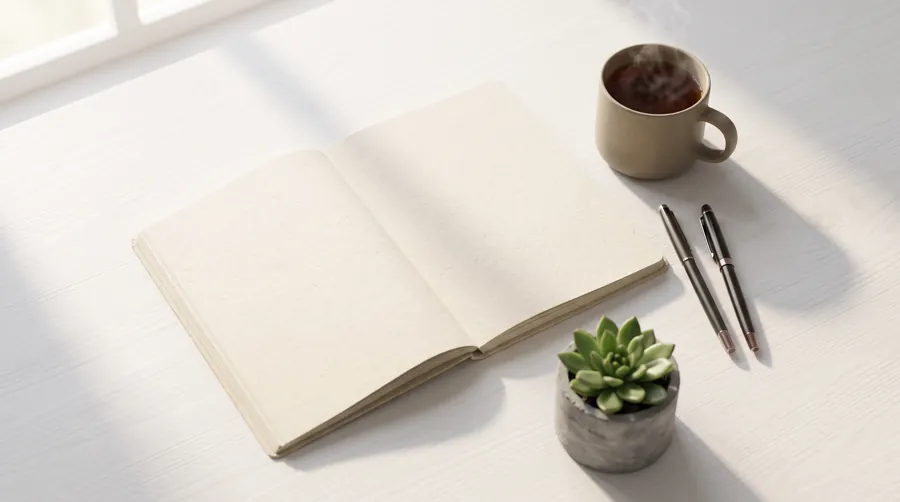
30 Gratitude Journal Prompts for Adults
Prompts About People
- Who helped you this week without being asked? What specifically did they do?
- Name someone you have not thanked properly. What would you say if you wrote them a letter right now?
- Think of a person who disagreed with you and turned out to be right. What did that teach you?
- Who in your life makes the ordinary parts of the day better? What do they do?
- Name a relationship that has gotten easier over time. What changed?
- Think of a stranger or acquaintance who did something small but kind recently. Describe the moment.
- Who taught you a skill you still use? How often does it show up in your daily life?
Prompts About Your Body and Environment
- What did your body do well today that you usually take for granted?
- Describe one sensory detail from today that you actually liked, a smell, a texture, a sound.
- What part of your home, however small, genuinely makes you feel comfortable?
- Name one physical ability you have now that you did not fully appreciate five years ago.
- What about your current season or weather has an underrated upside?
Prompts About Work and Competence
- What is one thing you did well at work or in a project this week, even if no one noticed?
- Name a skill you have developed over the last two years. How did you build it?
- Describe a problem you solved this month that used to feel unsolvable.
- What is one aspect of your work, paid or unpaid, that you would genuinely miss if it vanished?
- Think of a difficult conversation you handled better than you expected. What went right?
Prompts About the Past
- What is a hardship from your past that gave you something you could not have gotten any other way?
- Name a mistake you made that turned into useful information. What did you learn?
- Describe a moment from childhood that you still feel warm about when you remember it.
- What decision, that felt risky at the time, worked out in your favor?
- Name one thing about where you grew up that quietly shaped who you are.
Prompts About Small and Ordinary Things
- What convenience in your daily life do you consistently undervalue?
- Name one food or drink that reliably makes a bad day slightly better.
- Describe the best ten minutes of yesterday. What made them good?
- What habit or routine do you have that quietly keeps your life running?
- What piece of technology, however mundane, genuinely improves your life?
Prompts for Harder Days
- On a day when nothing went well, what did not go wrong? Be specific.
- What is one thing keeping you stable right now, even if everything else feels unstable?
- Name one thing you are grateful for that you would normally be embarrassed to admit.
A Simple Free Gratitude Journal Template You Can Use Today
You do not need to buy anything to start. A basic gratitude journal template has three fields per entry:
| Field | What to Write | Time |
|---|---|---|
| Date + one prompt | Copy any prompt from the list above | 30 seconds |
| Your response | Write until you stop, no minimum length | 3 to 10 minutes |
| One sentence close | "The thing I want to remember from this entry is..." | 1 minute |
That structure takes five to twelve minutes. If you want a printable PDF version, the Greater Good Science Center at Berkeley offers a free downloadable gratitude journal practice guide (see Sources). For a digital option, a plain notes app works as well as any dedicated journal, possibly better, because it is always in your pocket.
What the Research Actually Shows (Without Overpromising)
The 2025 PNAS meta-analysis by Choi, Cha, McCullough, and colleagues is the most comprehensive review to date: 145 papers, 163 samples, 727 effect sizes, 28 countries. The overall well-being effect was small (Hedges' g = 0.19), which is honest. This is not a therapy replacement. But a small, consistent positive effect from a five-minute daily habit is a genuinely good return.
Separately, a 2023 randomized controlled trial published in a peer-reviewed oncology journal found that gratitude journaling produced a statistically significant improvement in spiritual well-being for breast cancer survivors, with a large effect size within that intervention group. The mechanism appears to involve attention retraining: writing forces you to complete a memory search for positive events, and repeated memory searches for positive events gradually shift what your brain surfaces first.
One thing the research does not support: journaling every single day outperforming journaling three times a week. Sonja Lyubomirsky, a researcher at UC Riverside, found in her own studies that once-weekly grateful reflection produced stronger results than daily journaling for some participants. Over-doing it can turn the practice into a chore, stripping the reflective quality that produces the benefit. Three sessions a week is a reasonable target.
Video: How to Build a Gratitude Habit With Journal Prompts
This video walks through nine journal prompts designed to help build a gratitude habit from scratch, covering why generic "list five things" instructions tend to stall and how specific questions change the experience. Worth watching before you sit down with your first entry.
Key Takeaways
For more articles on building a more purposeful daily life, visit the Personal Growth category.
- Gratitude journaling has a real, small, well-documented effect on mood, anxiety, and sleep, confirmed across dozens of randomized trials.
- Blank-page failure is a prompt problem, not a motivation problem. Specific questions outperform open-ended instructions.
- Three sessions per week, 5 to 15 minutes each, is the research-supported dosage. Daily is not necessarily better.
- You do not need a special journal. A notes app, a printed template, or a spiral notebook all work equally well.
- Prompts about people, competence, and "what did not go wrong" tend to produce the most substantive entries.
- The practice builds a memory-retrieval habit over time. The longer you do it, the faster your brain surfaces positive material without prompting.
Frequently Asked Questions
How long should a gratitude journal entry be?
There is no minimum. Three sentences that engage genuinely with a prompt will outperform a paragraph written on autopilot. Research by Lyubomirsky and colleagues suggests that quality of reflection matters more than length. If you are writing five things in under two minutes without pausing to think, you are completing a task rather than doing the practice.
What is the best time of day to write in a gratitude journal?
The research does not strongly favor morning or evening. Morning journaling helps set an attentional tone for the day. Evening journaling allows you to review what actually happened. The more important variable is consistency of timing. Attaching the habit to an existing anchor, right after morning coffee or right before you set your phone down for the night, matters more than which end of the day you choose.
Can I use a gratitude journal PDF or template instead of writing freely?
Yes, and for most people a template works better than a blank page, at least to start. A template reduces the decision load and keeps sessions short. The Greater Good Science Center at UC Berkeley offers a free gratitude journal practice guide. Once the habit is established, you can move to free writing if you want more flexibility.
Does gratitude journaling work if life is genuinely difficult right now?
The evidence suggests it can help, with an important caveat. The effect is not about pretending problems do not exist. Prompts 28 through 30 in the list above are specifically designed for hard periods, focusing on what did not collapse rather than what went well. Several clinical trials have tested gratitude journaling specifically in high-stress populations, including cancer patients and healthcare workers, and found measurable benefits even in those contexts. Start small, use concrete prompts, and do not grade yourself on the depth of your entries.
Sources
- Effects of Gratitude Journaling on Patients with Breast Cancer: A Randomized Controlled Trial (NIH/PMC)
- A meta-analysis of the effectiveness of gratitude interventions on well-being across cultures (PNAS, 2025)
- The effects of gratitude interventions: a systematic review and meta-analysis (PubMed, 2023)
- Gratitude Journal Practice Guide (Greater Good Science Center, UC Berkeley)
- Pilot Study on the Impact of Gratitude Journaling or Cognitive Strategies on Health Care Workers (PubMed)
Wellness Tabloid is reader-supported: this page shows ads and some outbound links may be affiliate links.
Fact-checked against cited sources. Reviewed by the Wellness Tabloid editorial team.