How to Build Good Habits and Break Bad Ones at the Same Time


Building good habits and breaking bad ones do not have to be separate projects running on separate timelines. The brain uses the same neural loop for both, which means the most efficient approach runs them together: you replace the bad behavior with the good one, recycling the same cue and reward. Research from MIT's McGovern Institute shows that habits live in the basal ganglia and become highly resistant to willpower-based removal, but they can be overwritten when a competing behavior is practiced consistently in the same context.
This article walks through the mechanism, gives you a concrete framework for doing both at once, and gives realistic timelines based on actual published data, not the "21 days" myth. The mechanics here connect directly to living more intentionally: habits are the infrastructure of a values-aligned life, and understanding how they form makes it far easier to steer them deliberately.
TL;DR
- Run both as one project: keep the bad habit's cue and reward, and swap in a new routine that gives the same payoff.
- Expect about 66 days on average to go automatic, not the mythical 21 (complex behaviors can take up to 254).
- Make the replacement tiny (two minutes) and pre-plan it as an "if [cue], then I will [routine]" rule.
Why the 21-Day Rule Is Wrong (and What the Data Actually Shows)
The "21 days to form a habit" idea traces back to a 1960 self-help book by plastic surgeon Maxwell Maltz, who noticed his patients took about three weeks to adjust to a new appearance. It was never a study. It was one doctor's observation, and it got repeated until it sounded like fact.
The real number comes from a 2010 study by Phillippa Lally and colleagues at University College London, published in the European Journal of Social Psychology. They tracked 96 people attempting a new eating, drinking, or exercise behavior daily over 12 weeks. The median time to automaticity, meaning the point where participants did the behavior without consciously thinking about it, was 66 days. The full range was 18 to 254 days, depending on the complexity of the behavior and the person.
A 2024 systematic review and meta-analysis from the University of South Australia, published in PLOS ONE and indexed in PMC, confirmed this and added a useful practical note: missing a single day did not meaningfully set people back. The process is forgiving. It is also slower than most people expect, and that gap between expectation and reality is exactly where most habit attempts fail.
The Habit Loop: How Your Brain Actually Wires Behavior
Neuroscientists at MIT, particularly Ann Graybiel's lab, ran experiments with rats running a T-maze to reach chocolate. Early on, the prefrontal cortex (the deliberate, effortful part of the brain) was highly active throughout the task. After enough repetitions, that activity collapsed down to just two moments: the start and the end. The middle, the actual behavior, shifted to the basal ganglia and became automatic.
Charles Duhigg organized this into a model most people now call the habit loop:
- Cue: The trigger that starts the sequence (a time, location, emotional state, or preceding action)
- Routine: The behavior itself
- Reward: The outcome that signals to the brain this loop is worth storing
The NIH describes this as chunking: the brain packages an entire behavioral sequence into a single unit, so it can run in the background and free up attention for other things. That is genuinely useful when the routine is good. It is genuinely costly when it is not.
The key insight for breaking bad habits: you almost certainly cannot eliminate the cue or the craving, but you can swap the routine. The NIH's research matters page notes that even after a habit is replaced, the original pathway does not disappear. It weakens through disuse but stays encoded. That is why stress or exhaustion can resurrect old habits, sometimes after years. You are not curing the old habit; you are building a stronger competing one.

The Replacement Strategy: Building and Breaking in One Move
Running a habit build and a habit break as one project looks like this in practice:
- Identify the existing cue and reward. Write down the bad habit and ask: what triggers it? What does it give me? The trigger is usually specific (3 PM energy slump, sitting down after dinner, opening a laptop). The reward is usually one of a small set: stress relief, stimulation, social connection, a moment of ease.
- Pick a replacement routine that satisfies the same reward. If you want to stop scrolling Instagram when you feel anxious, the replacement needs to also reduce anxiety. A two-minute breathing exercise does. Checking email does not.
- Stack the new habit onto the existing cue. Keep the trigger exactly the same. The brain already fires that cue reliably; there is no need to build a new prompt from scratch.
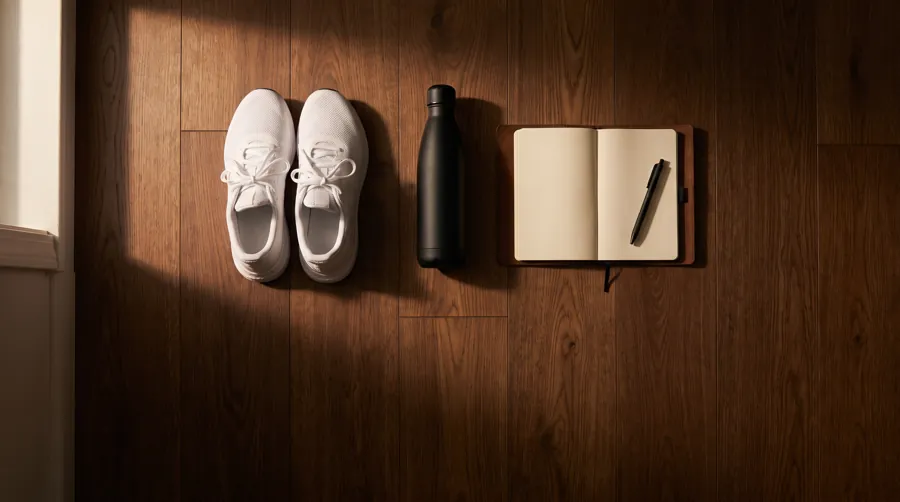
- Make the new behavior smaller than you think it needs to be. BJ Fogg, who directs the Behavior Design Lab at Stanford University, argues that the size of a habit matters less than its placement. A two-minute walk after lunch every day builds more durable automaticity than a 45-minute run "when I feel motivated." Motivation is unreliable. The cue-routine link is not, once built.
Implementation Intentions: The Research-Backed Planning Trick
One of the most consistently replicated findings in behavior change research is the power of what psychologists call implementation intentions: if-then plans that pre-decide your response to a specific cue.
The format is simple: "If [cue], then I will [new routine]."
Examples:
- If I sit down at my desk in the morning, then I will write three sentences before opening any app.
- If I feel the urge to snack after dinner, then I will drink a glass of water first and wait five minutes.
- If I open a new browser tab out of boredom, then I will close it and stand up for 30 seconds.
The research on this is not new. Peter Gollwitzer at NYU has published extensively on implementation intentions since the 1990s, and multiple meta-analyses show they significantly improve follow-through across health behaviors, academic performance, and exercise. They work because they remove the decision from the moment it is hardest to make.
Good Habits Worth Building (and the Bad Ones They Can Replace)
Here is a practical pairing table for common habit swaps:
| Bad Habit | Likely Cue | Likely Reward | Replacement Habit |
|---|---|---|---|
| Morning phone scroll | Alarm goes off | Stimulation, easing into wakefulness | 5 minutes of light stretching or journaling |
| Afternoon junk food snack | Energy dip around 3 PM | Quick energy, break from work | 10-minute walk + small protein snack |
| Late-night social media | Getting into bed | Mental wind-down, stimulation | Reading physical book for 15 minutes |
| Skipping workouts | End of workday | Avoiding discomfort, getting home faster | Lay out gym clothes the night before; two-minute start rule |
| Procrastinating on difficult tasks | Sitting down to work | Short-term relief from discomfort | Pomodoro: commit to just 25 minutes, no outcome requirement |
Study Habits Specifically: What Actually Works for Students
Building good study habits is a version of the same problem, with a few extra complications. The cue is rarely consistent (class schedules shift, assignments vary), and the reward is delayed by days or weeks, which makes the loop harder to wire. For the morning specifically, a structured morning checklist can provide the reliable cue that study schedules often lack.
What helps:
- Fixed location. Studying in the same physical spot every time builds context-dependent automaticity. The location becomes the cue. This is why the library works better than a different cafe every day.
- Fixed time window, not duration. "I study from 7 to 9 PM" is a better cue structure than "I study for two hours." The clock is more reliable than the intention.
- Pre-commitment. Closing all tabs except the one you need before you sit down. Putting your phone in another room. The NIH habit research notes that environmental design reduces the friction required to execute the bad habit, and for study habits, distraction is the bad habit you are fighting.
- Small consistent doses beat long sporadic sessions. Thirty minutes per day, five days a week, outperforms a three-hour Sunday cram session for long-term retention, per decades of spacing effect research.
What to Do When You Slip
You will miss days. The Lally study is unambiguous on this: missing one day does not meaningfully affect the eventual formation of the habit. The danger is not the skip. It is the story you tell yourself after the skip, specifically the "I already failed, so I might as well give up" thought pattern. Pairing a brief reflection practice with this, even something as simple as jotting down what did go right that day, can interrupt that spiral before it derails the whole effort.
James Clear calls this the "never miss twice" rule in Atomic Habits. The first miss is an accident. The second miss is the start of a new habit. One imperfect execution keeps the chain intact psychologically; zero executions breaks it.
The more useful reframe: a habit is a vote for who you want to be, not a performance you either pass or fail. The 66-day median is not a deadline; it is an average. Some behaviors click in six weeks. Others take six months. What matters is that you keep making the vote.
James Clear on the specific mechanics of habit building and breaking, including the implementation intentions approach discussed above. Worth 45 minutes if you want the full framework.
Key Takeaways
For more strategies on personal development, see all articles in the Personal Growth category.
- Habits form over a median of 66 days (not 21), and can take up to 254 days for complex behaviors.
- You cannot reliably eliminate a bad habit; you replace its routine while keeping the same cue and reward.
- The habit loop (cue, routine, reward) is the mechanism to work with, not against.
- Implementation intentions ("if X, then I will Y") significantly improve follow-through and require no willpower in the moment.
- BJ Fogg's core insight: make the new habit smaller than feels meaningful. Two minutes beats zero minutes every time.
- Missing one day does not reset your progress. Missing two days back-to-back is the pattern to avoid.
- Environmental design (removing friction for the good habit, adding friction for the bad one) does more work than motivation.
Frequently Asked Questions
How long does it actually take to build a good habit?
The most cited research, Lally et al. 2010 from University College London, found a range of 18 to 254 days, with a median of 66. A 2024 systematic review from the University of South Australia confirmed the median sits between 59 and 66 days for health behaviors. Simpler habits (drinking a glass of water after breakfast) form faster than complex ones (a 30-minute daily exercise routine). The 21-day figure is not supported by any clinical research.
Can you build a new habit and break a bad one at the same time?
Yes, and this is often more effective than treating them as separate efforts. Because the brain stores habits as cue-routine-reward sequences, you can replace the routine while keeping the existing cue and reward structure intact. This approach works with the brain's existing wiring rather than fighting it. The NIH describes this as habit substitution, and it has stronger research support than cold-turkey removal.
What are the best habits to build first?
Start with habits that have a clear, existing cue and a fast, tangible reward. Morning behaviors tend to form more easily than evening ones, according to the 2024 University of South Australia meta-analysis, likely because willpower and decision fatigue are lower earlier in the day. Daily movement, consistent sleep timing, and a brief morning or evening review are all well-supported starting points because they compound into other areas of life.
Why do bad habits come back after I have already quit them?
Because the original neural pathway does not disappear. NIH research on habit decay shows that old habits remain encoded in the basal ganglia even after they have been suppressed. Stress, fatigue, and environmental cues that match the original trigger can all reactivate them. This is not a personal failure; it is how the brain is built. The solution is to continue reinforcing the replacement behavior during high-stress periods specifically, and to reduce environmental exposure to the original cue where possible.
Sources
1. Lally, P., van Jaarsveld, C.H.M., Potts, H.W.W. and Wardle, J. (2010). How are habits formed: Modelling habit formation in the real world. European Journal of Social Psychology, 40: 998-1009. https://onlinelibrary.wiley.com/doi/abs/10.1002/ejsp.674
2. Singh, B., Murphy, A., Maher, C., & Smith, A.E. (2024). Time to Form a Habit: A Systematic Review and Meta-Analysis of Health Behaviour Habit Formation and Its Determinants. PLOS ONE. https://pmc.ncbi.nlm.nih.gov/articles/PMC11641623/
3. National Institutes of Health. (2012). Breaking Bad Habits. NIH News in Health. https://newsinhealth.nih.gov/2012/01/breaking-bad-habits
4. National Institutes of Health. Old Habits Gone But Not Forgotten. NIH Research Matters. https://www.nih.gov/news-events/nih-research-matters/old-habits-gone-not-forgotten
5. Fogg, B.J. Stanford Behavior Design Lab. https://behaviordesign.stanford.edu/people/bj-fogg
Wellness Tabloid is reader-supported: this page shows ads and some outbound links may be affiliate links.
Fact-checked against cited sources. Reviewed by the Wellness Tabloid editorial team.