The Morning Routine Checklist for People Who Are Not Morning People

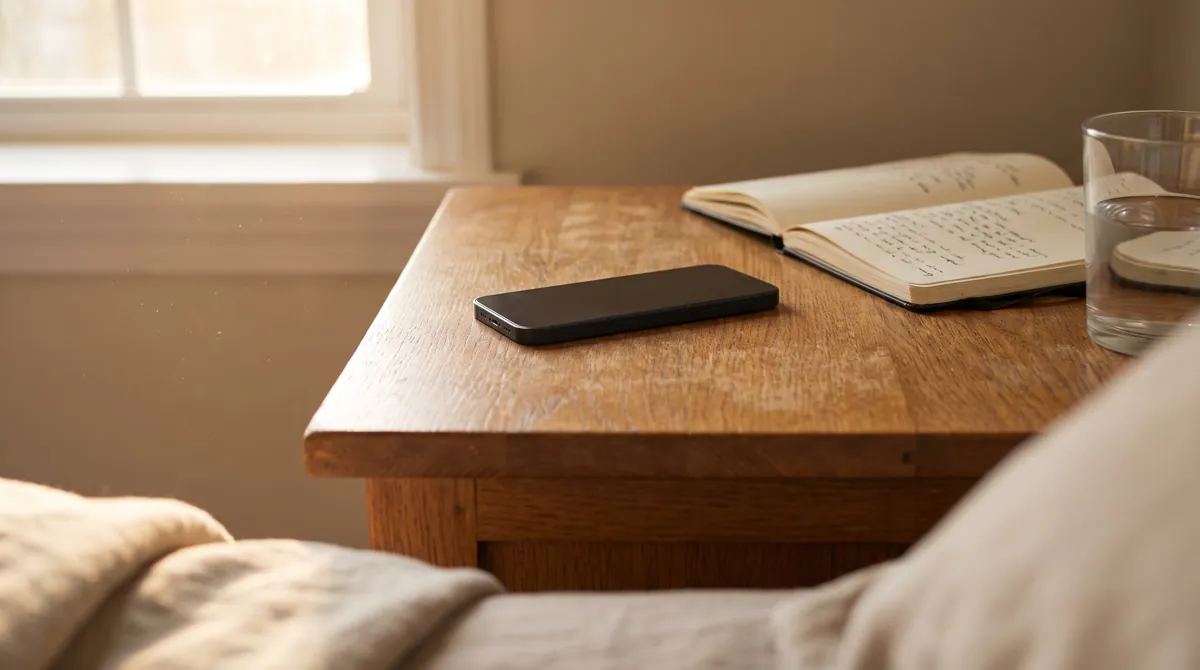
A solid morning routine checklist does not require you to enjoy mornings. It requires about three to five specific actions, done in the right order, starting within the first few minutes of waking. Most people fail at mornings because they build a routine designed for someone else entirely, not because mornings are inherently hard.
TL;DR
- The whole checklist: water within five minutes of waking, light on your face, one bit of movement, something real to eat, and one intention for the day. Five items, in that order.
- Pre-decide the exact first action the night before. In one study, that simple trick lifted morning follow-through to 94.2%, versus 75.8% without it.
The Problem with "Perfect" Morning Routines
Search "morning routine" and you will find 5 AM wake-ups, cold plunges, 45-minute workouts, journaling, meditation, and a green smoothie, all before 7 AM. That advice is not wrong for the people it was written for. It is just irrelevant to everyone else.
If you are not a morning person, a routine built around peak-performance habits will collapse on day two. You will hit snooze, skip the workout, feel guilty, and repeat. The goal is not to transform yourself into a different person by 8 AM. The goal is to get out the door (or onto your first task) feeling functional rather than wrecked.
This is a different starting point, and it leads to a different checklist. If you are also trying to cut the phone-scrolling habit that tends to eat the first twenty minutes of many mornings, the thinking behind a low-dopamine morning approach pairs well with the steps below.
What Science Says About the First 30 Minutes
Your body is not passive during the first half-hour after waking. Research published in Frontiers in Neuroscience (2022) confirmed that the cortisol awakening response (CAR) produces a sharp spike in cortisol within the first 30 minutes of waking, driven by the circadian system. This is your body's natural alerting mechanism. You cannot manufacture more of it with willpower, but you can work with it or against it.
Working against it looks like: lying in bed scrolling your phone, which delays physical movement and prolongs the fog. Working with it looks like: light exposure, a small amount of physical activity, and hydration within that first window.
Research from Hou et al., published in the Journal of Global Health (2020), adds something important: basic daily routines like hygiene, sleep timing, and eating act as a buffer against psychological stress. The finding that stands out most is this one: consolidating existing routines requires fewer cognitive resources than building new ones. That means your goal is not to add ten new habits. It is to lock in three or four basics and repeat them until they run on autopilot.
The Actual Checklist
This is a morning routine list built for people who need things to be short, real, and doable at 70% energy.
- Get water into your body within five minutes of waking. A full glass. Keep it on the nightstand if you have to. This is not a wellness cliché. Eight hours without fluids is a long time. Some people add a pinch of sea salt and lemon to speed up absorption; if that idea interests you, the case for morning electrolytes is worth a read.
- Get light on your face. Open blinds, step outside for two minutes, or sit near a window. Natural light helps calibrate your circadian rhythm and accelerates the cortisol spike that is already happening anyway.
- Do one physical thing. This can be 10 push-ups, a two-minute stretch, or a short walk to get coffee. The specific action matters less than the fact that your body moves before your brain starts managing your inbox.
- Eat something real. More on this below, but it does not have to be elaborate. Three minutes of breakfast prep counts.
- Set one intention for the day. Not a 10-item to-do list. One thing you need to accomplish by noon. Write it on paper or say it out loud.
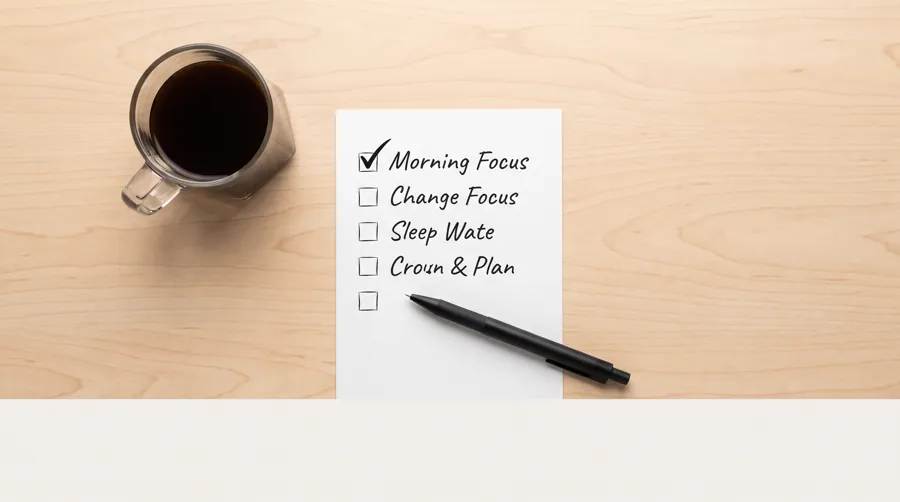
That is the whole checklist for most days. Five items. If you are doing a school morning routine with kids, add the logistics (bags, lunches, departure time buffer) but keep the personal items short. The checklist works because it is completable, not because it is comprehensive.
The Two Things That Matter Most
A 2022 study published in JMIR Formative Research (Oh et al.) put this problem under a microscope. Researchers identified three critical elements for successful morning behavior change: waking up on time, escaping sleep inertia, and quickly starting the target behavior.
Sleep inertia is the groggy, disoriented feeling in the minutes after waking. It is a real neurological state, not laziness. Your prefrontal cortex, the part of the brain responsible for decision-making and self-regulation, is not fully online yet. Decisions made during sleep inertia tend to default toward comfort: stay in bed, skip the workout, skip breakfast.
The study tested a "wake-up task" intervention where participants completed a picture-based task immediately after their alarm. The group using this method achieved a 94.2% success rate versus 75.8% for the conventional group, and they started their target behavior in just 7.7 seconds on average. The mechanism is simple: having a predefined physical action ready to execute removes the decision from a brain that is not yet equipped to make good ones.
Practical translation: decide the night before what the first thing you will do when your alarm goes off actually is. Not "get up and do my routine." Something specific: put your feet on the floor and pick up the glass of water on the nightstand. That specificity is what makes the difference.
Breakfast: Less Complicated Than You Think
A lot of people skip breakfast because they are not hungry in the morning, or because preparing food feels like too much friction before coffee. Both are valid.
Here is the actual evidence: a 2021 study published in PMC found that breakfast combined with morning exercise significantly improved performance on short-term mathematical tasks compared to either intervention alone. Cognitive performance, not just energy levels. If you are already adding a short bodyweight workout before breakfast, the combination is worth building around.
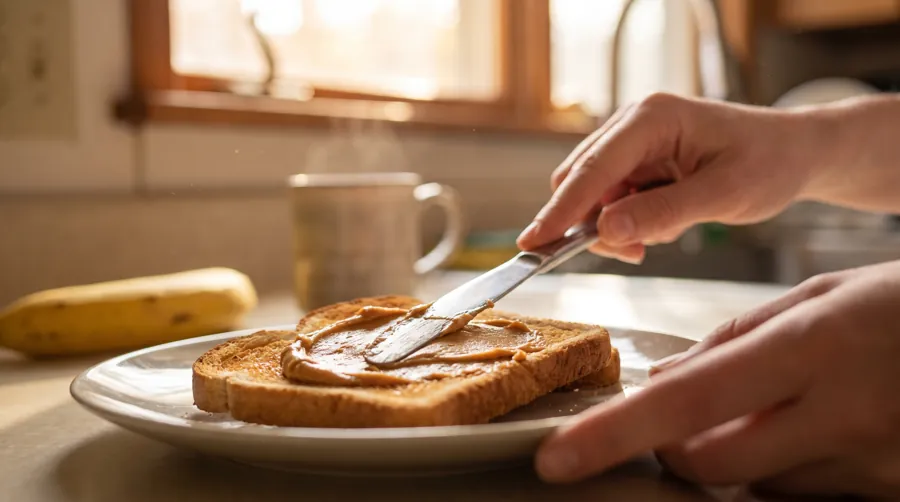
The barrier is not hunger. It is the idea that breakfast requires effort. Options that take under three minutes: a handful of nuts and a banana, a slice of whole-grain toast with peanut butter, Greek yogurt from the fridge. The preparation time objection disappears when you treat breakfast like a two-ingredient task rather than a meal.
If you genuinely cannot eat within the first hour of waking, a small amount of protein, even just a handful of almonds, is enough to avoid the blood sugar dip that makes 10 AM feel terrible.
How to Make This Stick Without Willpower
Willpower is a poor foundation for any routine. It depletes. It does not show up on the days you need it most. The routines that actually last are built on environment design and reduced friction.
A few concrete changes that cost nothing:
- Put the water glass on your nightstand before bed. Remove the decision entirely.
- Set your gym shoes or workout clothes next to the bed. Physical proximity is a cue. It works.
- Keep your phone charger outside the bedroom, or at minimum face the phone down. The phone is the single biggest threat to a functional morning for most people. This is also the first step recommended by anyone serious about protecting their morning attention.
- Go to bed at roughly the same time each night. The research from Hou et al. frames this as regularizing sleep, and it makes waking up significantly easier. A one-hour variance across the week is manageable. A four-hour variance is not. A calming evening wind-down routine is one of the most effective ways to make consistent bedtimes actually happen.
- Anchor new habits to existing ones. After I make coffee, I drink water first. After I get dressed, I take three deep breaths. After chains are easier to maintain than stand-alone habits.
The goal is to make the routine so low-effort that there is no real decision being made. You are just following a script that past-you wrote when your prefrontal cortex was fully operational.
Here is a video that covers exactly this kind of approach, an honest take on building a morning routine that does not require you to pretend you love 5 AM:
The creator here avoids the aspirational fantasy version and focuses on what is actually doable. That framing is more useful than most of the content in this space.
Key Takeaways
For more ideas across all the morning-focused habits covered on this site, the healthy habits category has everything organized in one place.
- Your cortisol spikes sharply in the first 30 minutes after waking. Work with that window, not against it.
- Sleep inertia is real and temporary. Pre-deciding your first action (not just your routine) is the fix.
- A morning routine checklist does not need more than five items to be effective.
- Breakfast does not have to be a meal. It has to be something real, eaten before cognitive demand ramps up.
- Environment beats willpower every time. Reduce friction the night before.
- Consistency of bedtime matters more than the length of your morning routine.
Frequently Asked Questions
What should be on a morning routine checklist?
At minimum: hydration (water immediately after waking), light exposure, one physical movement, a small meal or snack, and a single clear intention for the day. For a school morning routine, add practical logistics like packing bags and a fixed departure time, but keep the personal items to five or fewer. More items on the list means more chances for the whole thing to collapse when time is short.
How long should a morning routine be?
For most people, 20 to 30 minutes is enough. If your routine requires an hour, it will not survive a bad week. The length should reflect your actual life (school drop-offs, commute times, work start times), not the life of a person with no obligations before 9 AM. A 15-minute routine done consistently every day outperforms a 60-minute routine done twice a week.
How do you create a morning routine if you hate mornings?
Start with one change, not a full system. Pick the single most impactful item (usually water on the nightstand or phone out of the bedroom) and do only that for two weeks. Once it runs automatically, add the next item. Building incrementally is slower to describe but faster to actually stick. Also, identify what "hating mornings" really means: if it is sleep inertia, the fix is a predefined first action. If it is sleep deprivation, the fix is earlier bedtime. Those are different problems.
What is a low-dopamine morning routine?
A low-dopamine morning routine deliberately avoids high-stimulation inputs (social media, news feeds, notifications, TV) during the first hour of the day. The reasoning is that early exposure to variable-reward content (likes, headlines, messages) makes the rest of the morning feel comparatively dull and reduces motivation for non-digital tasks. A practical version: no phone for the first 30 minutes, replace scrolling with something physical or analog (a walk, journaling, a real breakfast). This is not about dopamine detoxing as a concept. It is about protecting your attention before the day takes it from you.
Sources
1. Oh, J. et al. (2022). Using Wake-Up Tasks for Morning Behavior Change: Development and Usability Study. JMIR Formative Research. https://pmc.ncbi.nlm.nih.gov/articles/PMC9529170/
2. Hou, W.K. et al. (2020). Regularizing daily routines for mental health during and after the COVID-19 pandemic. Journal of Global Health. https://pmc.ncbi.nlm.nih.gov/articles/PMC7535346/
3. Frontiers in Neuroscience (2022). Circadian System and Cortisol Awakening Response. Frontiers in Neuroscience. https://www.frontiersin.org/journals/neuroscience/articles/10.3389/fnins.2022.995452/full
4. PMC (2021). Breakfast and Exercise Combine to Improve Short-Term Mathematical Task Performance. PMC. https://pmc.ncbi.nlm.nih.gov/articles/PMC8068805/
Wellness Tabloid is reader-supported: this page shows ads and some outbound links may be affiliate links.
Fact-checked against cited sources. Reviewed by the Wellness Tabloid editorial team.